Most people think UFO history kicks off with Roswell in 1947. But if you look through old newspapers, ship logs, and even church records, you'll find UFO sightings before 1900 described in surprising detail. People back then didn't have the word "UFO," so they used the words they had: fiery wheels, ships in the sky, strange lanterns, or moving stars.
The 1561 Nuremberg Sky Event
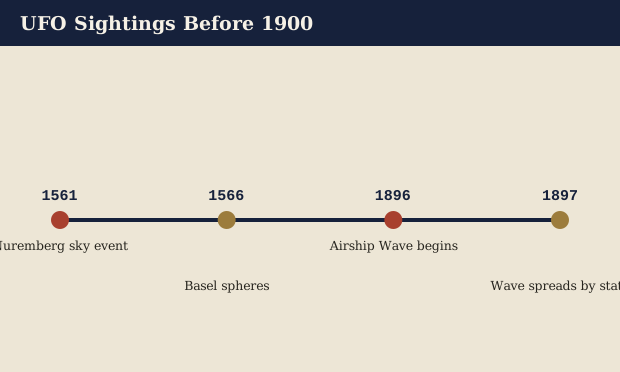
One of the most famous early reports comes from Nuremberg, in what is now Germany, in April 1561. Townspeople described the sky filling with crosses, tubes, and globes that seemed to fight each other before falling to the ground. A printed news sheet from the time, with a woodcut illustration, recorded the event for people who could not read. Historians still argue about whether this was an unusual weather event, like a sun halo with multiple reflections, or something else entirely.
The 1566 Basel Sighting
Five years later, in Basel, Switzerland, witnesses reported large black spheres moving in front of the sun, crossing paths and appearing to clash. Like the Nuremberg case, this event was printed and shared widely at the time, which tells us people considered it important enough to record for others.
The Great Airship Wave of 1896 and 1897
Right at the edge of our before-1900 window, the United States experienced what is now called the Airship Wave. Newspapers across states like California, Kansas, and Texas ran stories about a cigar-shaped "airship" with lights, seen by hundreds of witnesses over several months. Some articles even claimed the pilot spoke to farmers on the ground. This wave happened years before the Wright brothers built a working airplane, which is part of why it still puzzles researchers. For more on this shape of craft specifically, see our guide to types of UFO shapes explained.
Newspapers as Historical Evidence
It's worth remembering that 19th-century newspapers sometimes printed tall tales for entertainment, so not every airship story should be taken as fact. Still, the sheer number of separate reports, from different towns and different writers, makes the 1896-97 wave one of the most studied UFO sightings before 1900.
Older Reports From Ancient and Medieval Times
Go back even further and you find isolated mentions in old texts of "fiery shields" or "burning wheels" in the sky, described by monks, soldiers, and travelers. These accounts are harder to verify because record-keeping was less consistent and translations can shift the meaning of old words. We look at a few of these older cases in our article on ancient UFO sightings in history, including one written from the imagined point of view of a medieval chronicler trying to describe something he had no words for.
Why These Early Reports Still Matter
Looking at UFO sightings before 1900 reminds us that curiosity about strange things in the sky is not a modern invention. It also gives researchers a useful comparison point: if people across many centuries and cultures kept describing similar shapes, like discs, spheres, and wheels, that pattern is worth studying, whatever the eventual explanation turns out to be.

Sky Reports From Asia Before 1900
European and American cases tend to dominate English-language articles about this topic, simply because those sources are easiest for English-speaking researchers to find and translate. But historical Chinese and Japanese records include their own pre-1900 sky accounts, often written into official court chronicles as omens tied to the fortunes of a ruling dynasty. These records are less widely translated into English, which means they are still underexplored compared to the European cases, even though they may hold just as much historical value.
How Historians Check an Old Newspaper Story
Because 19th-century newspapers sometimes printed exaggerated or entirely made-up stories purely for entertainment, a careful historian never accepts a single old article at face value. Instead, researchers look for a few things: was the story picked up and repeated by other, independent newspapers at the time? Did the reporter name specific, identifiable witnesses? And does the story match any other known event, like a meteor shower or a genuine new invention, that might explain the excitement? The Airship Wave of 1896-97 passes some of these tests better than others, since it was reported across many separate towns and states, but it also included several stories later admitted by their own authors to have been invented for fun.
Frequently Asked Questions
Are any pre-1900 sightings considered fully proven?
No single pre-1900 case is considered proven in the way a modern radar-confirmed sighting might be. What survives are documented reports, meaning we can say with confidence that people described these events at the time, even though we can't always say for certain what caused them.
Why don't more people know about these older cases?
Modern UFO culture largely grew out of the 1947 Roswell and Kenneth Arnold stories, which became so famous that they overshadowed the older reports in most popular retellings.
Could the Airship Wave have been an early real aircraft?
It's very unlikely. No working powered aircraft existed anywhere in the world in 1896, which is exactly what makes the wave so puzzling to researchers who take the more credible individual reports seriously, even while dismissing many of the more obviously invented tall tales.
A Closing Thought on Reading Old Sources
The biggest lesson from studying UFO sightings before 1900 is patience. These stories reward slow, careful reading rather than quick conclusions. A 19th-century farmer describing an "airship" and a modern witness describing a drone are using completely different vocabularies to describe completely different centuries of technology, and a good researcher always keeps that gap in mind before drawing comparisons between them.
Related Reading
To see how these old reports connect to the wider historical record, check out our timeline of UFO sightings by decade, or jump straight to the very first known written account in our piece on the oldest recorded UFO sighting.