Ask a hundred different witnesses to draw what they saw, and you'll notice something interesting: the shapes repeat. There aren't hundreds of totally unique designs; there are a handful of common categories. Here are the main types of UFO shapes explained, along with what usually turns out to cause each one.
Learning these categories doesn't just satisfy curiosity; it actually helps investigators do their jobs faster. A report that matches a well-known shape pattern with a well-known explanation can often be resolved quickly, freeing up time and attention for the rarer, harder-to-categorize cases that deserve a closer look.
Shape descriptions also change slightly across cultures and eras, which is itself an interesting research thread. Older reports lean more heavily on saucer and cigar shapes, while more recent decades have added triangles and orbs to the mix, likely reflecting real changes in both technology overhead and the vocabulary witnesses have available to describe what they're seeing.
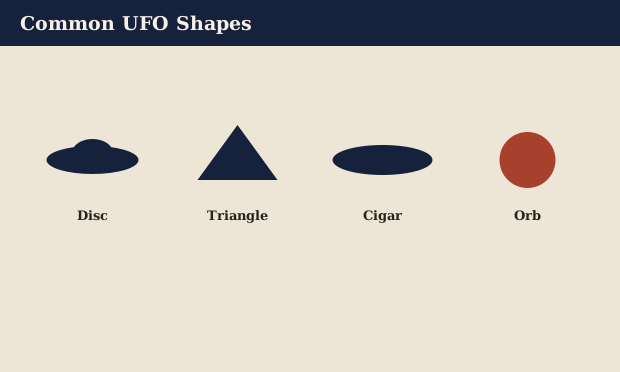
The Classic Disc or Saucer
This is the shape most people picture first, thanks to the original 1947 news coverage that coined the term "flying saucer." Disc-shaped reports often turn out to be a mix of things: distant aircraft seen from an angle that hides their wings, weather phenomena like lenticular clouds (which really do form a natural saucer shape), or, in some cases, genuine unexplained objects tracked on radar.
The Triangle
Triangle-shaped sightings became especially common from the 1980s onward, often described as large, silent, and slow-moving, with lights at each corner. A significant number of these reports have since been linked to specific stealth aircraft designs, which really do have a flattened, triangular shape and were kept secret from the public for years. The Belgian UFO wave of 1989 and 1990, one of the most documented triangle cases, involved hundreds of witnesses and even F-16 radar lock-ons.
Why Triangles Are Taken Seriously
Because triangle sightings often come with radar confirmation and multiple witnesses, they tend to be treated more seriously by investigators than a single, quick glimpse of a light. We go deeper into this pattern in our article on UFO sightings near military bases, since many triangle reports cluster around aviation testing areas.
The Cigar Shape
Cigar-shaped objects are usually described as long, cylindrical, and without visible wings or windows. This shape overlaps heavily with the historical "airship" reports from the 1896-97 wave covered in our article on UFO sightings before 1900. Modern cigar-shaped reports are frequently traced to blimps, distant aircraft seen head-on, or rocket bodies re-entering the atmosphere.
Orbs and Balls of Light
Orb-shaped sightings, small glowing balls of light, are actually the most commonly reported shape in modern data. Many turn out to be drones, Chinese lanterns, reflections, or camera lens artifacts (a "lens flare" can genuinely look like a glowing sphere in a photo). The wartime "foo fighter" sightings we cover in our article on UFO sightings during WWII are perhaps the earliest well-documented orb reports.
Why Shape Categories Matter for Research
Sorting reports by shape helps researchers spot patterns, like whether triangle sightings cluster near certain testing areas, or whether orb sightings spike during specific holidays known for lantern releases. It's one of the simplest but most useful tools in analyzing large datasets of UFO sightings statistics by year, which we cover separately.
Boomerang and Chevron Shapes
Less common than discs, triangles, or orbs, boomerang and chevron-shaped reports describe a wide, angled shape, sometimes compared to a flying wing. These reports increased notably after the public became more aware of experimental "flying wing" aircraft designs, and a share of chevron reports have since been connected to specific stealth bomber test flights. Because this shape is rarer overall, individual reports tend to get more focused attention from researchers when they do come in.

Why Some Shapes Are Rarer Than Others
The relative rarity of certain shapes tells its own story. Orbs and lights are extremely common because almost anything glowing at night, from a drone to a planet to a lantern, can look like a simple ball of light from a distance. Detailed shapes like triangles or chevrons require a much closer, clearer view to identify accurately, which naturally makes them rarer in the data, but also, in many researchers' view, more significant when they are reported by multiple independent witnesses.
Frequently Asked Questions
What's the most commonly reported UFO shape?
Orbs and simple lights are by far the most common shape reported in most large sighting databases.
Do all triangle sightings turn out to be stealth aircraft?
No. While a significant share have been linked to known aircraft designs, not every triangle report has been fully explained this way, and some remain genuinely unresolved.
Has any shape category been officially confirmed as alien in origin?
No. No shape category has been officially confirmed by any government as being of extraterrestrial origin. Shape alone is only ever one piece of a much larger investigation.
A Quick Shape Reference
Disc: often distant aircraft or lenticular clouds. Triangle: frequently linked to stealth aircraft designs. Cigar: commonly blimps or head-on aircraft. Orb: usually drones, lanterns, or lens artifacts. Boomerang or chevron: rare, sometimes linked to flying-wing test aircraft. Keeping this rough reference in mind makes reading any new sighting report much easier to evaluate quickly.
Why Learning the Shapes Matters
Understanding these repeating categories is one of the fastest ways to become a more careful reader of UFO news. When a report describes a shape that matches a well-known pattern, like a lantern-style orb or a lenticular-cloud disc, you can often make a reasonable guess about the likely explanation before an official investigation ever concludes.
Related Reading
See how many of these shaped reports eventually get a normal explanation in our article on UFO sightings that were later explained, or check out recent visual evidence in our page on UFO sightings caught on camera.