So you've just seen something in the sky that you genuinely can't explain. Before the memory fades or gets mixed up with what other people say, it helps to know how to report a UFO sighting properly. Here's a clear, simple process anyone can follow.
Good reporting isn't complicated, but it does take a bit of discipline right when your instinct might be to just stare or grab your phone and panic. A calm, methodical approach in the first few minutes after a sighting makes a real difference in how useful your eventual report will be to anyone reviewing it later.
Think of yourself, for a few minutes, as a careful witness rather than just an excited bystander. The goal isn't to prove anything or convince anyone of a particular explanation. It's simply to record what actually happened as accurately as possible, in your own words, so that someone reviewing the report later has real, usable detail to work with.
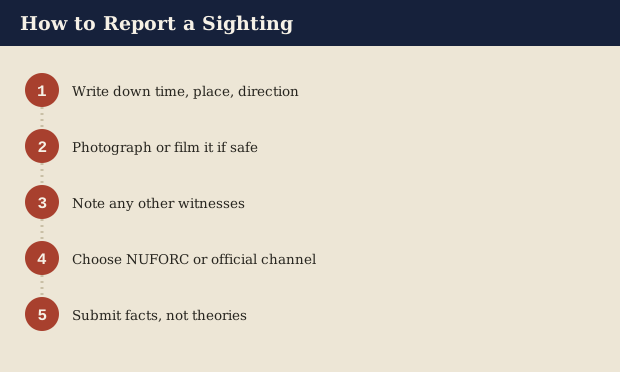
Step 1: Write Down What You Saw, Right Away
Memory changes fast, especially for something unusual and stressful. As soon as you can, write down the time, your exact location, the direction you were facing, how long you watched it, and what it actually did: did it hover, move in a straight line, change direction suddenly, or blink? Try to describe size by comparing it to something familiar, like "about the size of a coin held at arm's length," rather than guessing feet or meters.
Step 2: Take a Photo or Video If It's Safe To
If the object is still visible and you can safely grab your phone, take a photo or short video. Don't zoom in digitally if you can avoid it, since that usually just makes the image blurrier. A shaky, wide, unedited video is actually more useful to investigators than a heavily zoomed one.
Avoid Editing the Image
Investigators want the raw file, not a filtered or cropped version. If you plan to report the sighting, keep the original photo or video file exactly as your camera saved it.
Step 3: Note Any Other Witnesses
If other people saw it too, ask if they'd be willing to give a separate, independent account. Multiple witnesses describing the same event from slightly different angles is some of the most valuable evidence a sighting can have.
Step 4: Choose Where to Report It
In the United States, civilians can report sightings to the National UFO Reporting Center (NUFORC), a long-running civilian organization that has logged sighting reports for decades. If you are military personnel or a commercial pilot, reports typically go through official channels connected to AARO, the government office we cover in our article on what AARO stands for.
Step 5: Fill Out the Report Form Honestly
Stick to what you actually saw. Don't guess at explanations like "it was definitely a drone" or "it had to be alien" in your report itself; just describe the observed facts. Investigators are trained to weigh the plain description far more heavily than a witness's personal theory.
What Happens After You Submit a Report
Civilian databases like NUFORC log the report and, depending on the details, may follow up for more information. Some sightings are cross-checked against known flight paths, satellite schedules, or weather balloon launches, which explains a surprisingly large number of cases. We look at exactly how many cases end up explained in our article on UFO sightings that were later explained.
What Not to Do When Reporting a Sighting
A few common mistakes can weaken an otherwise good report. Avoid digitally zooming into a photo before saving it, since this reduces image quality permanently. Avoid combining what you saw with what you later read online, since it can be easy to accidentally "fill in" details that weren't part of your original memory. And avoid waiting too long to write things down; even a few days can blur exact timing and direction, two of the most useful details for cross-checking a report against flight records or astronomical data.
Reporting Options Outside the United States
If you're outside the United States, the reporting landscape looks a little different. Many countries don't have one single official civilian reporting body the way NUFORC operates. Instead, sightings are often logged with independent regional research groups, university research projects, or international databases that accept reports from anywhere in the world. If you're in the United Kingdom, for example, our article on UFO sightings in Newcastle touches on how regional reports typically get handled.
Frequently Asked Questions
Will my name be made public if I report a sighting?
Most civilian databases allow you to submit a report with limited personal information shown publicly, though policies vary by organization, so check the specific reporting form before submitting.
Is there a time limit for reporting an old sighting?
No. Many databases accept reports of sightings from years or even decades ago, though more recent reports are generally easier to investigate thoroughly.
Do I need special equipment to make a useful report?
No. A clear written account with accurate timing and direction is often more useful than blurry footage from expensive equipment. Good observation matters more than good gear.
Why Your Report Actually Matters
It's easy to assume a single report gets lost in a huge pile of data, but individual, well-documented reports are exactly what allow researchers to spot genuine patterns, like a cluster of similar sightings in one region on one night. A careful, honest report, even of something that turns out to have a simple explanation, adds real value to the overall record.
Related Reading
Curious how your report fits into the bigger picture? Check out our page on UFO sighting statistics by year, or learn the UAP vs UFO difference so you understand which term applies to what you saw.